
Water heaters are the appliance nobody thinks about until there's cold water or a wet floor. They're also one of the few where an hour of attention a year genuinely changes how long they last.
Here's what a real annual service covers — including the parts you can do yourself, and the parts where it's worth having someone with a meter and a wrench.
The annual checklist
| Item | Why | DIY? |
|---|---|---|
| Flush the tank | Sediment steals capacity and insulates the burner | Yes, with care |
| Test the T&P relief valve | It's the safety device; a stuck one is dangerous | Cautiously |
| Check the anode rod | Corrodes so the tank doesn't — the real lifespan item | Usually a plumber |
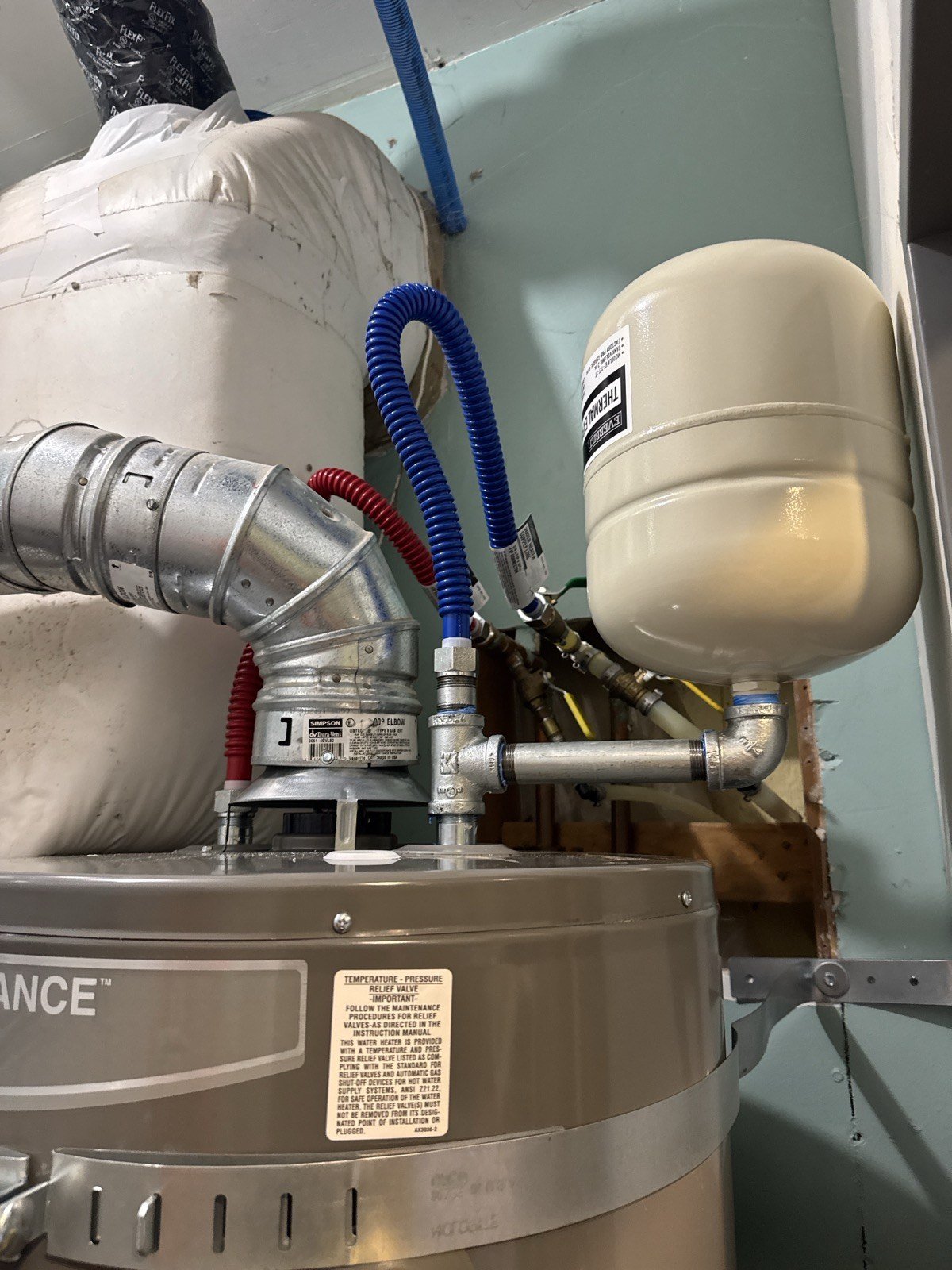
| Check the expansion tank | Waterlogged one causes relief valve discharge | Yes — tap test |
| Inspect connections | Corrosion at fittings leaks from the top down | Yes — visual |
| Verify temperature | 120°F balances scald risk and bacteria | Yes |
| Check seismic strapping | Required in Oregon, often missing | Yes — visual |
| Burner & venting (gas) | Combustion safety and draft | Plumber |
| Drain pan & line | Only helps if it's clear and routed | Yes — visual |
How to flush a tank water heater
Set aside about 45 minutes, most of which is waiting.
- Turn off the heat first. Electric: flip the breaker. Gas: control valve to "Pilot" or "Off." Do this before anything else — an electric element that fires in a partly drained tank burns itself out immediately.
- Close the cold water supply at the valve on the pipe entering the top of the heater.
- Let it cool. Give it a couple of hours, or run a hot tap until it's no longer hot.
- Hook up a garden hose to the drain valve near the base, running to a floor drain or outside — and downhill from the tank.
- Open a hot tap somewhere in the house. This lets air in so the tank can actually drain.
- Open the drain valve and let it empty. Expect cloudy water and grit.
- Flush out what's left. With the drain still open, briefly crack the cold supply to stir the bottom and push sediment out. Repeat until it runs clear.
- Refill completely before restoring heat. Close the drain, open the cold supply, and leave that hot tap open until water runs steady with no sputtering. Only then turn the power or gas back on.
Two things that go wrong. First, scalding — tank water sits at 120–140°F and people rush the cooling step. Second, the drain valve: plastic ones on older heaters sometimes won't reseal once you've opened them, and now you have a slow drip you didn't have this morning.
If your heater is past about ten years old and has never been flushed, let someone else do the first one. That's exactly the situation where a stuck valve or a dislodged sediment layer turns a maintenance job into a replacement.
The item people skip that matters most
Flushing gets all the attention. The anode rod deserves more of it.
It's a sacrificial metal rod inside the tank whose entire job is to corrode instead of your tank's steel walls. It works exactly as designed right up until it's consumed — and then the corrosion moves to the tank itself.
Checking it and replacing it before it's spent is the single highest-value thing you can do for a tank's lifespan. It's also the thing almost nobody does, which is why plenty of heaters die at eight years that could have gone twelve or more.
Worth inspecting annually past about the five-year mark. If you're already seeing rust-coloured hot water, that's usually the signal you're past the point where a new rod helps.
Testing the relief valve
The temperature and pressure relief valve is the safety device that keeps a water heater from becoming a pressure vessel problem. It should be exercised once a year.
Lift the lever briefly and let water discharge through the tube, then release. It should stop cleanly. Two things to know: keep clear, because what comes out is scalding, and occasionally an old valve that's never been tested won't reseat afterward and will need replacing. That's not a reason to skip the test — it's a reason to know the valve was already failed.
If your relief valve discharges on its own between tests, that's a pressure problem, not a valve problem. Usually a waterlogged expansion tank. We covered that in why water shows up under a water heater.
The expansion tank tap test
Takes five seconds. Tap the expansion tank: the top should sound hollow, the bottom solid. Solid all the way up means it's waterlogged and no longer absorbing anything — and your relief valve is doing that job instead.
Tankless is different, and needs it more
A tankless unit needs an annual descale, circulating a descaling solution through the heat exchanger to clear mineral buildup.
The stakes are higher than with a tank. A tank with scale buildup gets less efficient. A tankless heat exchanger with scale buildup starts throwing error codes and can fail outright — and skipped maintenance is one of the more common reasons a warranty claim gets denied.
If you're weighing the two, that ongoing cost belongs in the comparison. We put the full numbers in tankless vs. a 40 or 50 gallon tank.
How often, for Portland specifically
Once a year is the standard answer, but your water changes the math.
On the Bull Run supply — most of Portland proper — the water is notably soft and low in minerals. Sediment builds slowly, and tanks often reach the longer end of the eight-to-twelve year range. Annual is still right, but you'll see less come out.
On harder groundwater blends — parts of Washington County including Hillsboro and Beaverton — sediment accumulates faster and the annual flush earns its keep. If you're out this way and have never flushed, that's the first thing to schedule.
Either way, if you've got a tankless, don't stretch the descale interval. That one isn't optional.
While you're down there
Three things worth a look that take a minute each:
- Seismic strapping. Required in Oregon and missing on a surprising number of older installs. Two straps, upper and lower third of the tank.
- The connections at the top. Crusty white or green buildup is dissimilar-metal corrosion. Light is normal; heavy or damp means it's deteriorating and will eventually leak.
- The drain pan and its line. A pan only helps if the drain line is clear and actually goes somewhere. Plenty aren't and don't.
What we do on an annual visit
When we install a water heater, we sign customers up for a return visit about a year later — flush or descale, full inspection through the checklist above, and a quick walk-through of the rest of the home's plumbing while we're there. You get told what we found, what's worth doing now, and what can wait.
That last part matters. Plenty of visits end with "everything's fine, see you next year," and that's a perfectly good outcome.
Genuinely — call with questions even if you're doing it yourself. If you're mid-flush and the drain valve won't close, or you're not sure whether that crust on the fittings is a problem, ring us at (971) 225-3567. We'd rather talk you through it than have you find out the hard way. No charge for a question.
Common questions
How often should I flush it?
Once a year for a tank; annually and non-negotiably for a tankless. Harder water in parts of Washington County makes it matter more than on Portland's Bull Run supply.
Can I do it myself?
On most tanks, yes. Heat off first, cold supply closed, let it cool, drain through a hose. Watch for scalding and for old plastic drain valves that won't reseal.
Does flushing really extend its life?
It helps, mostly by protecting capacity and burner efficiency. The anode rod does more for actual lifespan.
My heater is 12 years old and never been flushed — should I now?
Have someone else do the first one. That's the exact scenario where a stuck valve or disturbed sediment layer turns maintenance into a replacement.
Do tankless units need this too?
More than tanks do. Annual descale, and neglecting it is a common reason warranty claims get denied.
Questions, or want us to handle it?
Happy to answer questions whether you're doing it yourself or want it booked. We service tank and tankless across Hillsboro, Beaverton, Portland and 17 more metro cities.
New to us? Why homeowners pick us.