
This is one of the most common calls we get, and it's also the one where homeowners most often get sold something they didn't need. Someone sees water at the base of the tank, hears "your water heater's leaking," and forty-five minutes later there's a new heater on the invoice.
Sometimes that's genuinely the answer. Often it isn't. Here's how to tell the difference before anyone quotes you anything.
Do these two things first
If it's more than a few drops, cut the heat before you cut the water:
- Turn off the heat source. Electric: flip the breaker. Gas: turn the control valve on the front to "Off." Do this first. An electric element that fires while the tank is partly empty will burn itself out, and you'll have added a second problem to the one you already have.
- Close the cold water shutoff — the valve on the cold line entering the top of the heater. If there isn't one, or it won't budge, shut off the main.
Don't rush to drain the tank. The water in there is sitting between 120 and 140°F, and a garden hose running to a floor drain is a scald hazard if you're not set up for it. Draining also doesn't help a diagnosis — it removes the evidence.
The five things it's actually coming from
| Source | What you'll see | Verdict |
|---|---|---|
| T&P relief valve | Water at the end of the discharge tube near the floor | Repairable, usually cheap |
| Drain valve | Slow weep from the spigot near the base | Repairable, cheap |
| Supply connections | Wet path running down the outside of the tank from up top | Repairable |
| Condensation | Even beading over the tank, dries up as it heats | Usually not a leak at all |
| The tank itself | Water emerging from under the jacket, often rusty | Replacement |
1. The T&P relief valve is doing its job
Every tank has a temperature and pressure relief valve, with a discharge tube running down to within a few inches of the floor. That tube exists so that if the tank over-pressurizes, it dumps safely at floor level instead of somewhere dangerous. Which means a working safety device produces exactly what a leak looks like: water on the floor near the base.
Check the open end of that tube. If it's wet or dripping, your tank isn't leaking — it's venting, and something is causing it to.
Nine times out of ten around here, that something is thermal expansion with nowhere to go. Heat water and it expands. On a closed system, that extra volume needs an expansion tank to absorb it. When the expansion tank fails or becomes waterlogged, pressure climbs on every heating cycle until the relief valve vents. The other usual suspect is incoming street pressure above roughly 80 psi, which calls for a pressure reducing valve.
Quick expansion tank check: tap it. The top should sound hollow and the bottom solid. If it sounds solid all the way up, it's waterlogged and has stopped doing anything. That's a part, not a new water heater.
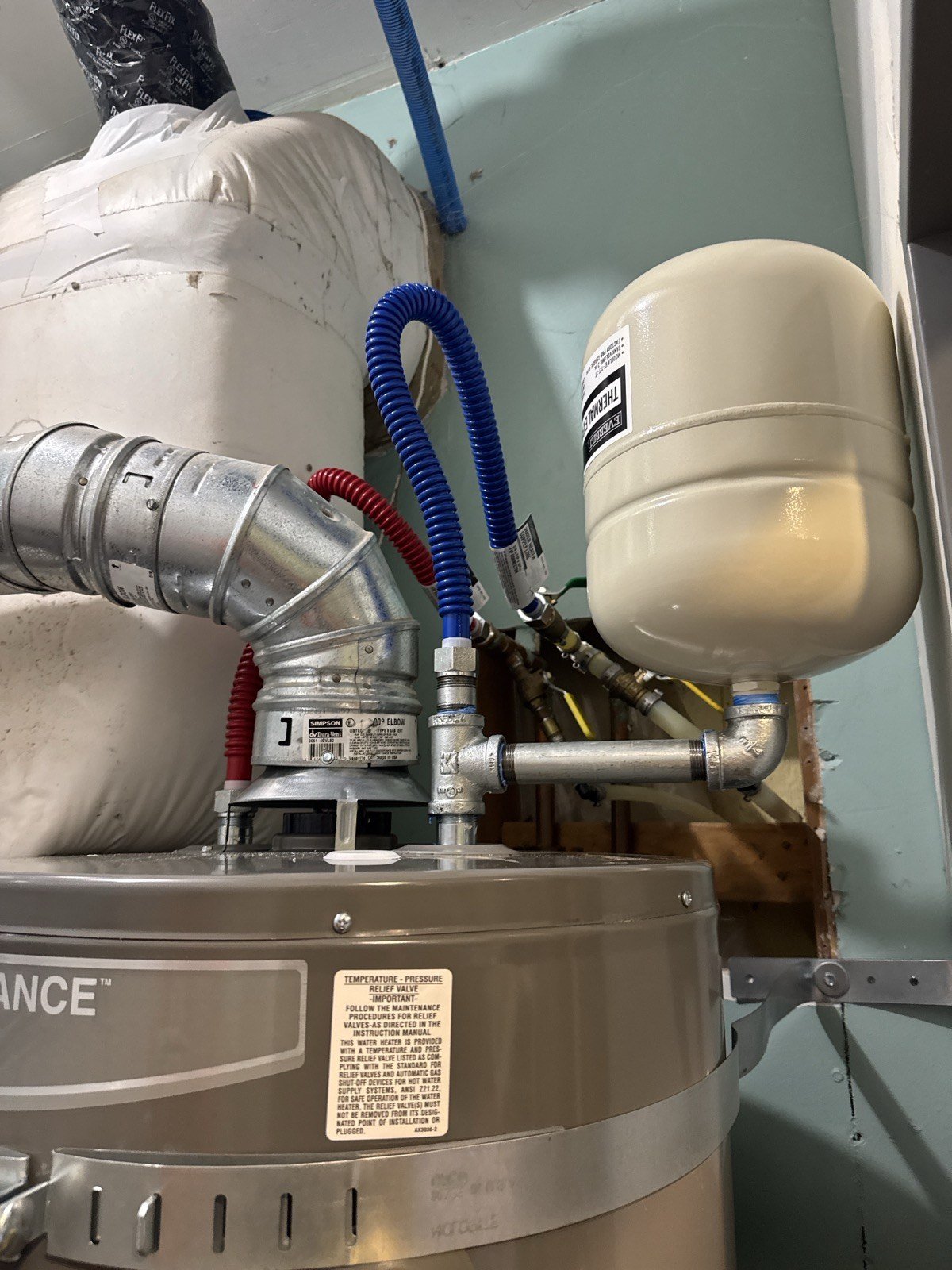
2. The drain valve is weeping
The spigot near the bottom of the tank is a drain valve, and the plastic ones fail quietly. Sometimes it's loose. Sometimes a bit of sediment is holding it fractionally open after someone last flushed the tank. Sometimes the valve body itself is cracked.
Dry it, wrap a paper towel around it, and check in an hour. This is one of the cheapest repairs in the trade and it perfectly mimics a dying tank, so it's worth ruling out first.
3. Something above is leaking and running down
This is the one that fools people most. The connections on top of the heater — flex lines, dielectric unions, the shutoff, sometimes a nipple that's corroded — can weep slowly. That water runs down the outside of the tank, under the jacket, and emerges at the base looking exactly like a tank failure.
Get a flashlight on the top of the heater and feel every connection. Then trace the tank down the sides. A wet vertical path is your answer.
4. It's condensation, not a leak
Gas units especially will sweat when a tank full of cold water meets humid air — the tank surface drops below the dew point and the whole thing beads up. That water drips down and pools.
Around here this shows up in exactly the places you'd expect: unheated garages, crawlspaces, and basements, most often on a damp morning or right after a big hot water draw refilled the tank cold. Condensation is even across the tank surface rather than tracking from a single point, and it clears as the water comes up to temperature. On a brand-new install, a few days of this is normal.
5. The tank has rusted through
Steel tanks are protected by a glass lining and a sacrificial anode rod. When the anode is spent and the lining cracks, the steel corrodes from the inside until it perforates. There is no repair for this. Welding it, sealing it, patching it — none of that is a real option on a pressurized vessel.
Tells: water appearing from under the jacket at the base with no wet path from above, rusty or discoloured water, soaked insulation, or staining down the tank's seam. If your unit is also past ten years old, that's your answer.
How to actually find out, in about an hour
- Dry the entire area and the tank itself, completely.
- Lay dry paper towel or flattened cardboard all the way around the base.
- Put a dry paper towel at the end of the T&P discharge tube and around the drain valve.
- Wait one to four hours without using much hot water.
- Look at which towel is wet first. Then trace upward from it — water travels down, never up.
That sequence answers the question most of the time, and it costs nothing. If the answer is the tank, you've lost an hour. If the answer is anything else, you've potentially saved yourself a replacement you didn't need.
How old is it, really?
Eight to twelve years is the normal service life for a standard tank. You don't have to guess at yours — the serial number on the rating plate encodes the manufacture date, and the format varies by brand but a quick search on the model and serial will date it.
There's a local wrinkle worth knowing. Homes on Portland's Bull Run supply tend to sit at the longer end of that range, because that water is notably soft and low in minerals, so tanks accumulate less sediment over the years. Parts of Washington County running on harder groundwater blends see more buildup, and sediment is what insulates the tank bottom, drives up burner run time, and accelerates the end. If you're in Hillsboro or Beaverton and you've never flushed the tank, that's worth doing annually.
Repair or replace
Relief valve, expansion tank, drain valve, supply connections — all repairs, all worth doing on a tank with life left in it. Our rate is $185/hour plus parts, standard hours Monday to Friday 8am to 4pm, and most of these are short visits. We publish that number because most plumbers won't, and we think that's backwards.
A perforated tank on a unit over ten years old is a replacement, and it's worth knowing that a replacement in Oregon isn't just a swap. It's a permitted job, and current code brings in seismic strapping, proper venting, an expansion tank on a closed system, and a drain pan where the location calls for one. A quote that skips the permit isn't cheaper — it's incomplete, and it surfaces later when you sell the house.
If the number is uncomfortable, we offer financing with a soft credit check that won't affect your score to see what you prequalify for. A failed water heater is rarely a well-timed expense.
When to stop reading and call someone
- Water is actively running rather than dripping — shut off the cold supply and call.
- You smell gas at any point. Leave, then call your gas utility from outside.
- The relief valve is discharging repeatedly. That's a pressure problem, and pressure problems don't fix themselves.
- The tank is in a finished space, upstairs, or over anything you care about.
- It's rusty water and the unit is over ten years old — you're spending money to confirm what you already know.
We handle water heater diagnosis, repair, and replacement across the Portland metro — Hillsboro, Beaverton, Portland and the surrounding cities — tank and tankless both. Emergency service is answered 24/7.
Common questions
Does water under my water heater always mean I need a new one?
No. Only one of the five common sources — the tank rusting through — requires replacement. The other four are repairs, and three of them are inexpensive. Dry the area and watch where water reappears before assuming the worst.
How do I tell if the tank itself is leaking?
Dry everything, lay dry paper towel around the base, and check in one to four hours. If water emerges from under the jacket with no wet path leading down from above — especially if it looks rusty — the tank has failed.
Should I shut it off if it's leaking?
For anything beyond a few drops, yes. Heat first — breaker for electric, control valve to "Off" for gas — then the cold water shutoff on top.
How long should a water heater last around here?
Eight to twelve years for a standard tank. Bull Run's soft water tends to push homes toward the longer end; harder groundwater blends in parts of Washington County tend to shorten it.
Why does the relief valve keep discharging?
Usually thermal expansion with nowhere to go — a failed or waterlogged expansion tank — or incoming pressure over about 80 psi. The fix is a part, not a water heater.
Not sure which one you've got?
Send us a photo of the base of the tank and the top connections. We'll tell you straight whether it's worth a service call.