
The photos in this article are from a crawlspace in the Portland metro. We were called out for one leak. What we found was a system that had already been repaired several times, by several different people, with several different materials — and that's the pattern worth understanding before you spend money on the next patch.
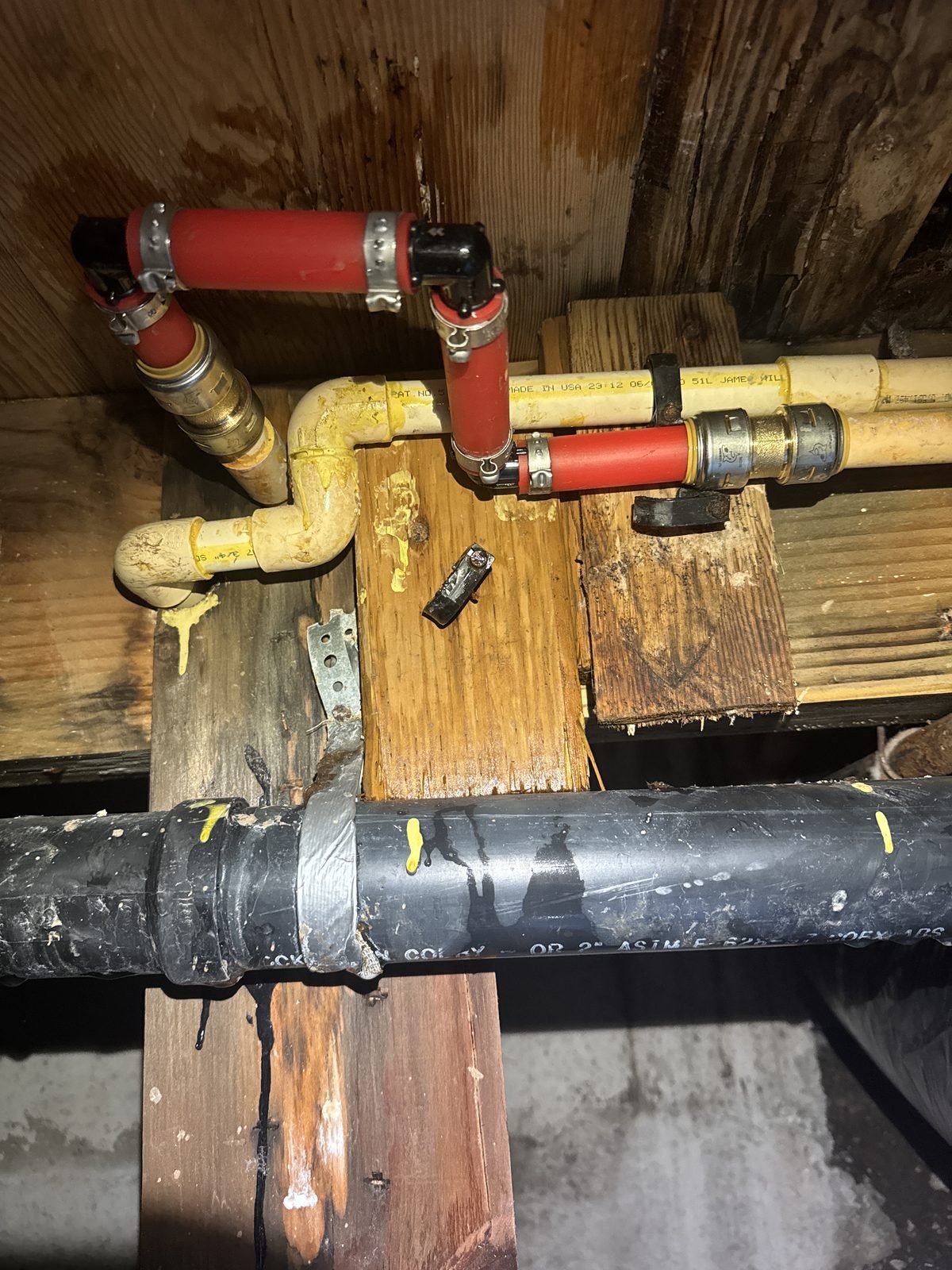
First: is it actually CPVC?
Homeowners mix these up constantly, and the distinction matters because they fail differently.
| Material | Looks like | Joints |
|---|---|---|
| CPVC | Rigid, cream or tan | Glued — yellow/orange cement smeared at fittings |
| Polybutylene | Flexible, grey | Crimped bands |
| PEX | Flexible, often red/blue/white | Crimp rings or clamps |
| Copper | Rigid, metal | Soldered |
If yours is grey and flexible, you've got a different conversation on your hands — see polybutylene pipes in older Portland homes. If it's rigid, cream-coloured, and has glue smeared around every fitting, keep reading.
Why old CPVC gets brittle
CPVC is a legitimate, code-approved material. Plenty of it performs for decades and we install with it where it's the right call. This isn't a "CPVC is garbage" article.
But it does age, and several things push it along:
- Time and hot water. Decades of thermal cycling on the hot side gradually stiffen the material.
- Chlorine and oxidizers in treated water slowly attack it from the inside.
- UV exposure before installation — pipe that sat in the sun on a job site starts life already degraded.
- Cold. Rigid plastics get more brittle as temperature drops, and an unheated Portland crawlspace in January is exactly that environment.
- Chemical contact. This one surprises people — see the warning below.
Things that shouldn't touch CPVC. Some spray foam insulation, petroleum-based products, certain thread sealants and tapes, and some fire-stop caulks can chemically attack CPVC and cause stress cracking. Manufacturers publish compatible-materials lists precisely because this is a known failure path.
If someone has foamed or insulated around CPVC in your crawlspace — a very common winterizing move — it's worth confirming the product was rated compatible. Well-intentioned insulation has killed a lot of pipe.
The part that costs people money
Here's the thing that makes aged CPVC different from a leaking copper joint, and it's the single most useful thing in this article.
CPVC joints are solvent welded. The cement chemically fuses pipe and fitting into one piece. There's no taking a joint apart — a repair means cutting the section out entirely.
And cutting a section out means moving pipe. You have to flex it to get a coupling on, support it, work around joists. On new CPVC that's fine. On thirty-year-old brittle CPVC, that flex travels down the run and lands on the next glued fitting — which has been sitting there under quiet stress for decades.
So you fix the leak under the kitchen, and a week later there's a new one eight feet away that had been holding fine until someone touched the system.
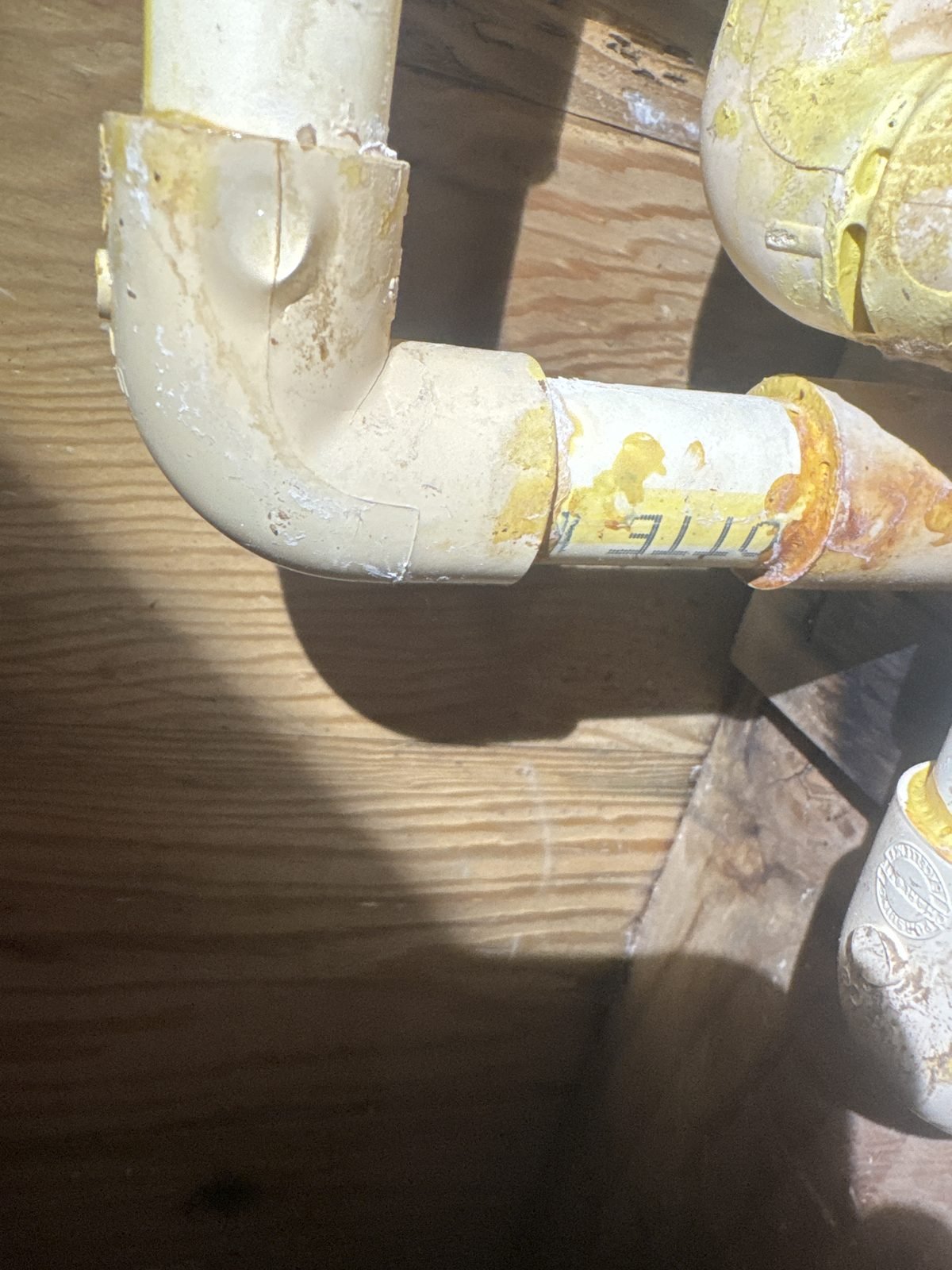
That crack isn't from impact. That's what brittle CPVC does when stress finds it.
Reading a crawlspace
You can learn a lot about a system's future from what previous repairs look like.
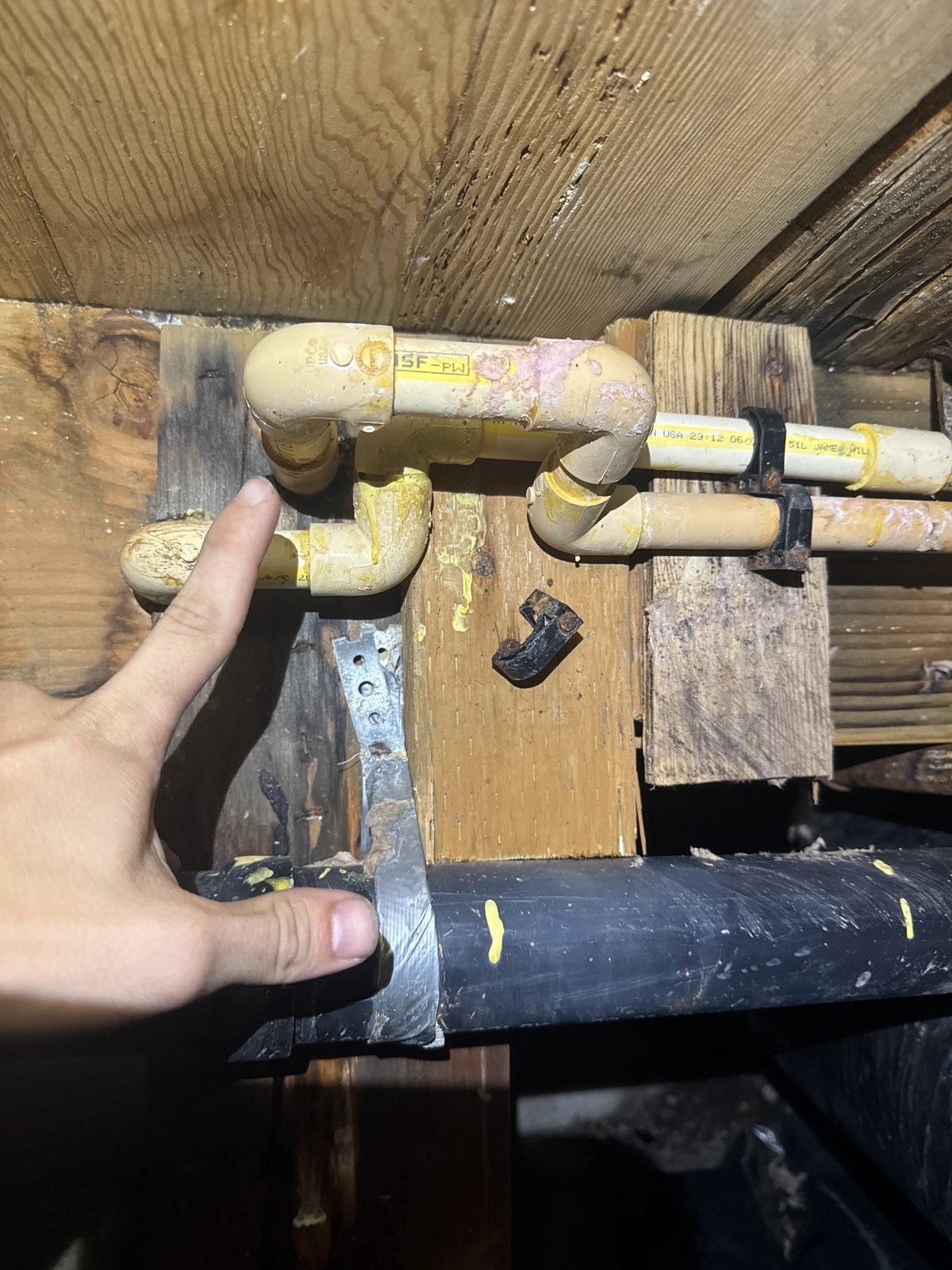
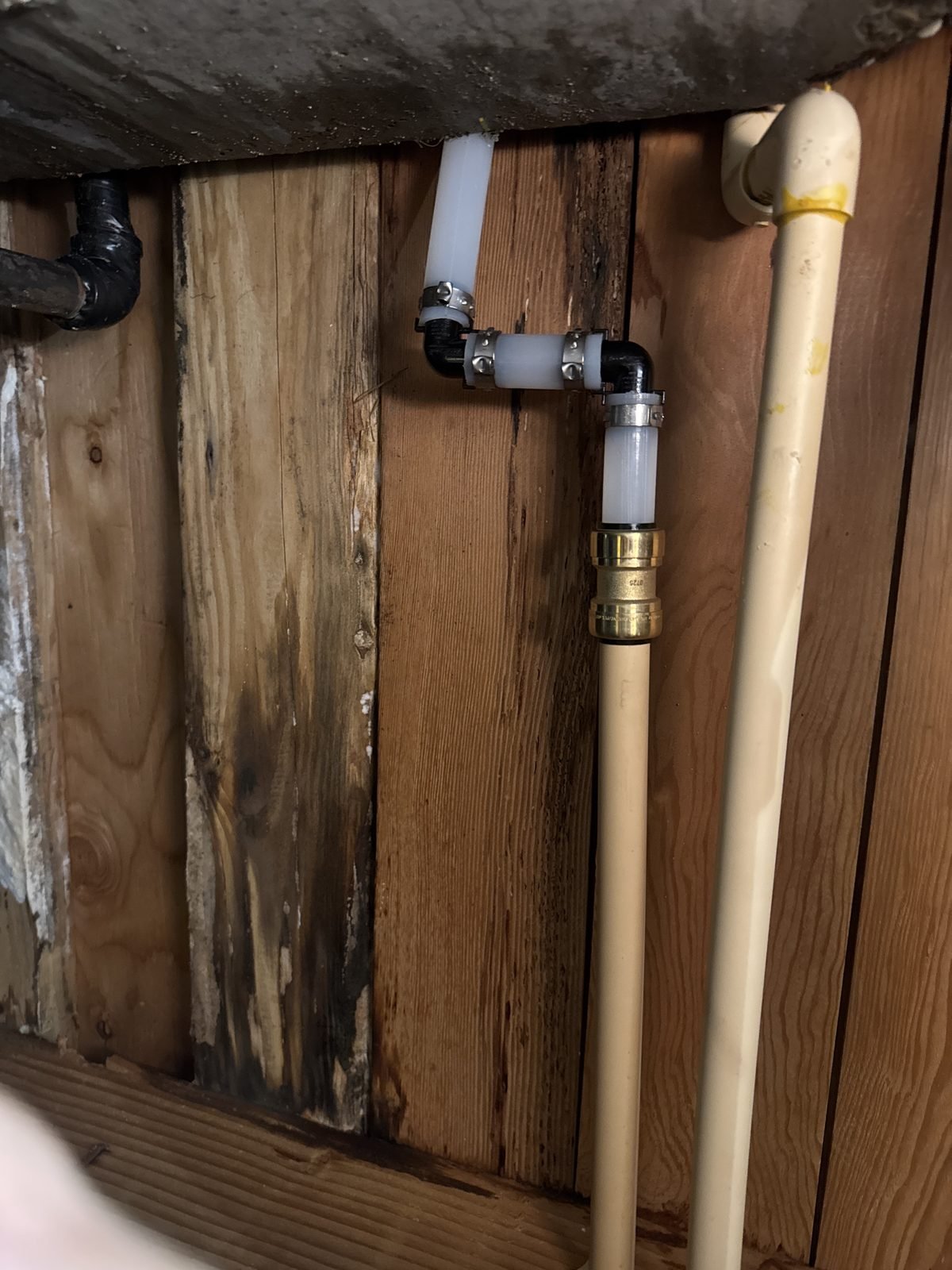
Signs this system is telling you something:
- Multiple materials. PEX here, push-fit brass there, original CPVC in between. Each transition marks a previous failure.
- Mineral or rust staining at fittings. Slow weeping that dried and left residue.
- Hairline cracks in fitting bodies, often running along the length.
- Stained or darkened subfloor and joists. The pipe tells you where it leaked; the wood tells you for how long.
- Tape on anything. Tape is not a repair. It's a note from a previous visitor saying "I knew about this."
Crawlspaces make all of it worse
Most Portland-area homes with CPVC have it running through an unheated crawlspace, and that setting adds three problems:
- Cold. Brittle material gets more brittle. Most CPVC failures we see cluster in the colder months.
- Nobody's looking. A slow leak under the house can run for months. Under a sink you'd notice in a day.
- What it lands on. Wet joists, wet subfloor, wet insulation. The plumbing repair is often the cheap part of the bill.
Repair or repipe?
We'll happily do either, and we'd rather tell you honestly which one your house needs.
Repair makes sense when…
- It's the first failure on an otherwise sound system.
- The rest of the pipe looks and handles like it has life in it.
- There's no history of patches.
It's a repipe conversation when…
- You've had multiple leaks in a couple of years.
- There are already several patches in different materials.
- Pipe cracks while being handled — that's the system telling you directly.
- You're seeing staining or cracks at more than one fitting.
At that point the arithmetic changes. Repeated emergency call-outs, plus the water damage each one causes, stops being cheaper than doing it once. And a repipe converts an unpredictable expense into a planned one — which is a real quality-of-life difference when the alternative is wondering what breaks next January.
We're not going to quote a repipe off a photo — the number depends on the size of the house, fixture count, access, and how much of the crawlspace is workable. But we'll come look and give you a real figure for free, and tell you plainly if we think you can get another few years out of what's there.
If the timing is bad, we offer financing with a soft credit check that won't affect your score.
If you have old CPVC and it isn't leaking
Leave it alone. Genuinely.
- Don't disturb it unnecessarily. Don't hang things off it, don't use it as a handhold in the crawlspace, don't push it aside to run a cable.
- Keep incompatible products away from it — check before foaming or spraying anything near it.
- Look at it once a year when you're down there. Staining and hairline cracks show up before the flood does.
- Know your main shutoff. With brittle supply pipe, the minutes between noticing and shutting off are what determines whether this is a plumbing bill or a restoration bill.
Common questions
How do I know if I have CPVC?
Rigid, cream or tan, glued joints with yellow or orange cement smeared around the fittings. Grey and flexible is polybutylene — different problem.
Why does it crack when you work on it?
Solvent-welded joints make the run one rigid piece. Aged pipe has lost flexibility, so flex applied in one place transmits to the next fitting and finds its weakest point.
Is CPVC bad pipe?
No — it's approved and plenty of it performs for decades. Aged CPVC in an unheated crawlspace is the specific problem.
Can I just keep patching?
You can, and sometimes that's the right financial call. But once repairs start causing new failures, each patch tends to buy months rather than years.
What shouldn't touch it?
Some spray foams, petroleum products, certain sealants and tapes, some fire-stop caulks. Check compatibility before insulating around it.
Got cream-coloured pipe and a bad feeling?
Send us a photo of your crawlspace. We can usually tell from a picture whether you're looking at one repair or a system nearing the end — and we'll tell you straight either way.
New to us? Why homeowners pick us.