CIPP Pipe Lining in Cedar Hills, Beaverton, OR
A real trenchless sewer rehabilitation project — no excavation, no torn-up yard, same-day restoration of a structurally failed sewer line.
Restore Your Sewer Without Digging Up Your Property
When most homeowners hear they need a sewer replacement, they picture excavators, torn-up driveways, damaged landscaping, and weeks of restoration work afterward.
That's not always the only option.
At True Flow Plumbing PDX, we specialize in modern trenchless sewer technologies that can often rehabilitate a damaged sewer from the inside — no dig required. For larger CIPP projects, we partner with our sister company Clog Busters LLC, combining 22+ years of field experience with industry-leading equipment.
This Cedar Hills project is a good example of how we approach it: camera inspection first, honest assessment of whether trenchless is the right call, then a clean CIPP installation that had the homeowner's sewer fully restored in a single day.
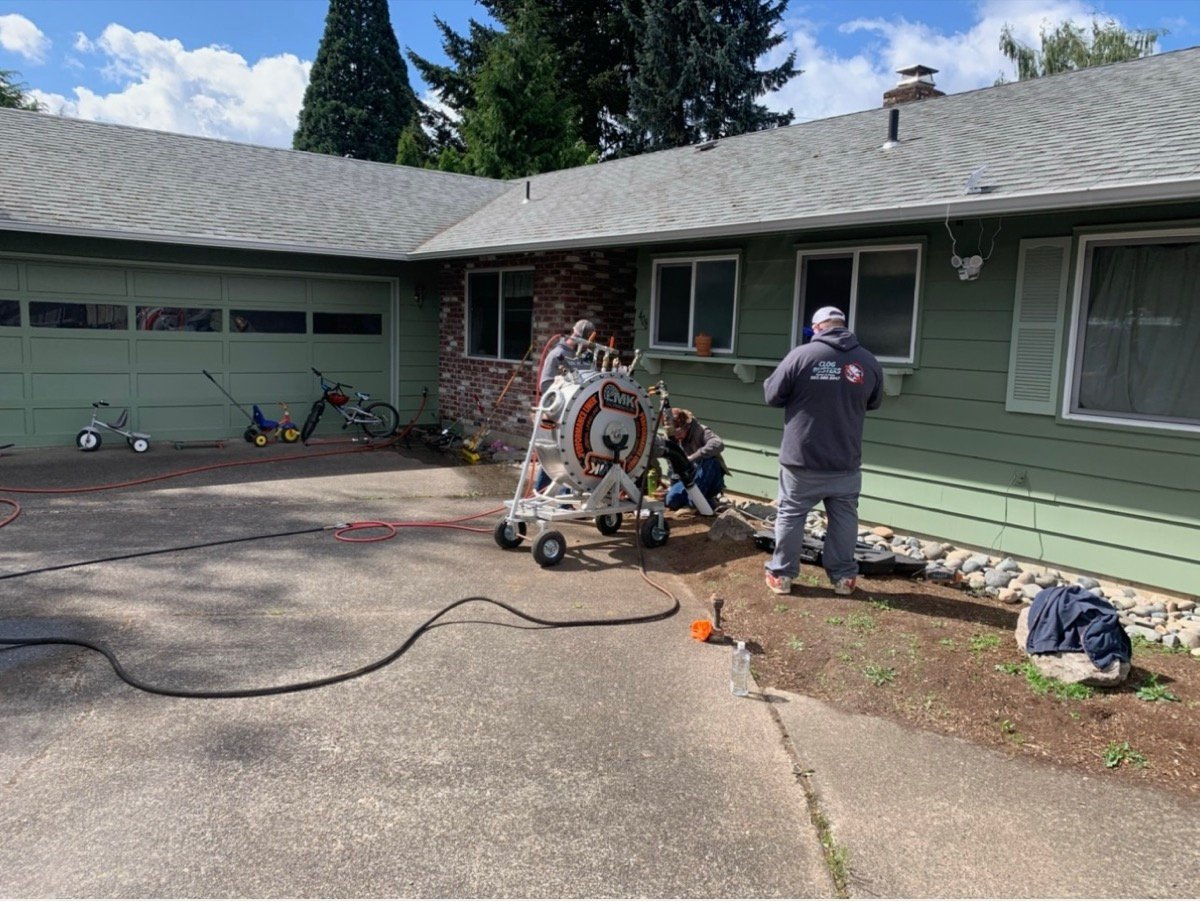
The LMK inversion drum positioned at the cleanout access point — liner installation underway, no yard excavation required.
Why This Cedar Hills Homeowner Chose CIPP
Like a lot of homes throughout Cedar Hills and Beaverton, this property had a sewer line that had been slowly deteriorating. After a complete sewer camera inspection, we could see the existing pipe was structurally compromised — but still intact enough to be an excellent candidate for trenchless rehabilitation.
Instead of recommending a full excavation across the front yard and driveway, we were able to install a structural cured-in-place liner through an existing cleanout access point. The homeowner avoided the disruption of major excavation and got a completely rehabilitated sewer in one visit.
That's the call we make on every job: look at what the pipe actually needs, not what the largest job would cost.
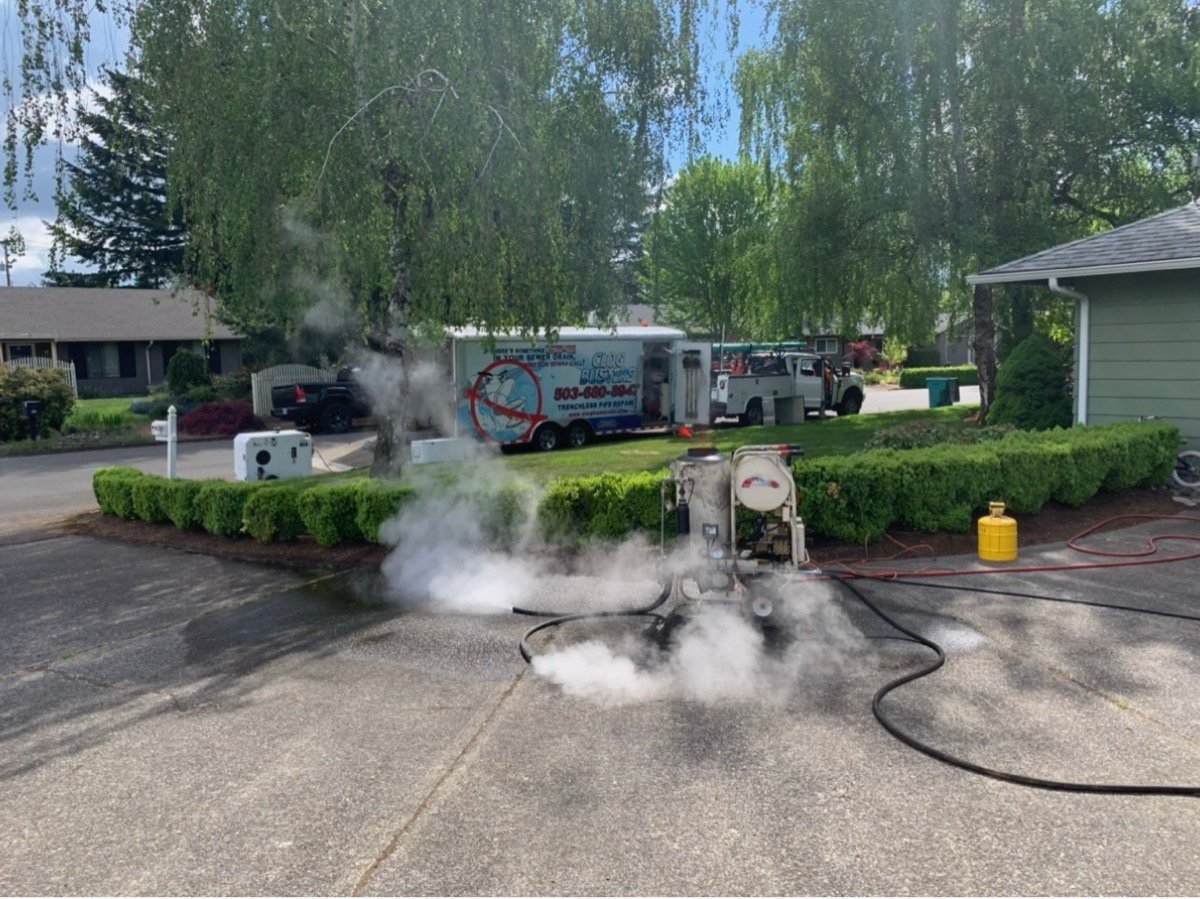
Steam rising during the controlled cure process — the liner is hardening into a structural pipe inside the existing sewer line.
What Is CIPP Pipe Lining?
Cured-In-Place Pipe (CIPP) is one of the most effective trenchless sewer rehabilitation methods available today. Rather than removing the existing pipe, a liner saturated with epoxy resin is installed inside the damaged sewer from an existing access point.
Once positioned, the liner is cured using controlled heat and pressure — creating a new, seamless structural pipe inside the original one. No joints means no future root entry points, and the smooth interior surface actually improves flow compared to a corroded or scaled original pipe.
The end result is a pipe that's structurally independent — it doesn't rely on the host pipe for support — with a design life measured in decades.
How This Project Was Completed
Every CIPP project starts with diagnostics, not assumptions. Here's the full sequence for this Cedar Hills job.
Complete Sewer Camera Inspection
We ran a camera through the full length of the sewer to evaluate pipe condition, identify defects, and confirm the line was a viable CIPP candidate — not collapsed or severely offset, which would change the recommendation.
Hydro Jetting & Cleaning
The line was thoroughly cleaned with a hydro jet to remove roots, scale, grease, and debris. A clean host pipe is critical for proper liner adhesion and a long-lasting install.
Precision Measuring
Every liner is custom-measured for the specific sewer being rehabilitated — diameter, length, and any bends in the line. Off-the-shelf sizing doesn't work for a structural repair.
Wet-Out Process
The liner was saturated with high-strength epoxy resin under controlled conditions to ensure consistent coverage throughout the full length of the repair.
Liner Installation via Inversion
Using the inversion drum you can see in the photos, the liner was installed through the existing cleanout access point — no excavation needed for this project.
Controlled Cure
The liner was cured under monitored temperature and pressure conditions until it became a rigid structural pipe inside the original sewer line.
Final Camera Inspection
After cure was complete, we ran the camera again to verify the finished liner — no voids, no gaps, clean terminations at both ends. The homeowner saw the before-and-after footage.
"One thing we noticed on this Cedar Hills project was that the existing sewer still had good structural integrity overall — the pipe was degraded but not collapsed or severely offset, which made it an excellent CIPP candidate. Had the pipe been collapsed or had significant joint offset, we would have recommended pipe bursting instead. Taking the time to properly diagnose the sewer before recommending a repair is exactly why we always start with a complete camera inspection."
— True Flow Plumbing PDX field notes, Cedar Hills project
Why Homeowners Choose Trenchless Over Dig-and-Replace
Traditional sewer replacement often requires excavating across your landscaping, sidewalks, patio, or driveway — and then paying to restore all of that after the pipe is in. When a sewer qualifies for CIPP lining, the math usually looks very different.
- Minimal to no excavation in most projects
- Landscaping and hardscape stay intact
- Faster completion — often same day
- No separate restoration costs for yard or concrete
- Seamless liner with no root entry joints
- Smooth interior improves flow over the original pipe
- Structural liner independent of the host pipe
- Long design life when properly installed
Every property is different — we always inspect before recommending anything.
Is Your Sewer a Candidate for CIPP?
Not every damaged pipe can be lined. We evaluate each situation based on:
Clay, cast iron, PVC, Orangeburg, and most common types can be lined.
Degraded but structurally present pipe is the ideal candidate.
Offset joints within a certain range can still be lined; severe offset may require bursting.
A collapsed section blocks liner insertion — pipe bursting or open cut is the alternative.
We confirm the liner fits the pipe diameter and that grade supports proper drainage.
Roots are cleared with hydro jetting first; the finished liner eliminates their re-entry points.
If CIPP isn't the right call, we'll explain why and recommend what is — pipe bursting, spot repair, or open-cut replacement when nothing else fits.
Common Questions About CIPP Pipe Lining
How long does a CIPP liner last?
A professionally installed CIPP liner is engineered for decades of reliable service when installed in an appropriate host pipe. The finished liner is structurally independent — it doesn't rely on the original pipe for support once cured.
Will tree roots come back after CIPP lining?
Because the finished liner is seamless with no joints, one of the most common root entry points is eliminated. Roots enter pipes through joints and cracks — a CIPP liner removes both. This is one of the most significant long-term advantages over pipe repair with new joints.
Will my yard be dug up?
Many CIPP projects — including this Cedar Hills job — require little or no excavation. Some homes need a small access pit or a new cleanout installed depending on the existing plumbing layout. We'll tell you exactly what your project requires before any work begins.
Is trenchless always cheaper than replacing the pipe?
Not always — it depends on pipe condition, length, access, and what restoration work would cost if you dug. That said, CIPP often saves significantly because there's no yard, driveway, or landscaping to restore afterward. We give you both options with honest numbers so you can decide.
What's the difference between CIPP lining and pipe bursting?
CIPP lining rehabilitates the existing pipe from the inside — the host pipe stays in place. Pipe bursting fractures the old pipe outward and pulls a new pipe through in the same path. Bursting is the right call when the pipe is collapsed or too degraded to support a liner; lining is better when the host pipe is still structurally present. We assess which applies during the camera inspection.
Do you serve Cedar Hills and Cedar Mill specifically?
Yes — Cedar Hills, Cedar Mill, and the broader Beaverton area are all part of our regular service area. We also serve Aloha, Hillsboro, Tigard, Lake Oswego, Portland, Gresham, and 20+ additional cities across the Portland metro. See our full service area map →
Trenchless Sewer Service Across the Portland Metro
We perform CIPP lining, pipe bursting, sewer camera inspections, and hydro jetting throughout the greater Portland area — not just Beaverton and Cedar Hills.
- Beaverton
- Cedar Hills
- Cedar Mill
- Aloha
- Hillsboro
- Tigard
- Portland
- Lake Oswego
- Tualatin
- Gresham
- Oregon City
- Sherwood
Not Sure If You Need CIPP?
A sewer scope inspection is the first step — it tells us exactly what's happening inside the pipe before we recommend any repair. See what we found during a recent camera inspection in nearby Oak Hills.
Think Your Sewer Might Need Attention?
Start with a camera inspection — we'll tell you exactly what's in there and whether CIPP, pipe bursting, or something else is the right fix. No sales pressure, just a straight answer.